Resource · The Technology
How nationwide walkie talkies work
A traditional walkie talkie shouts into the air and hopes someone nearby hears. A nationwide walkie talkie makes a phone call’s worth of network do the shouting — and that one change rewrites everything about range, cost, and failure modes.
The one-sentence version
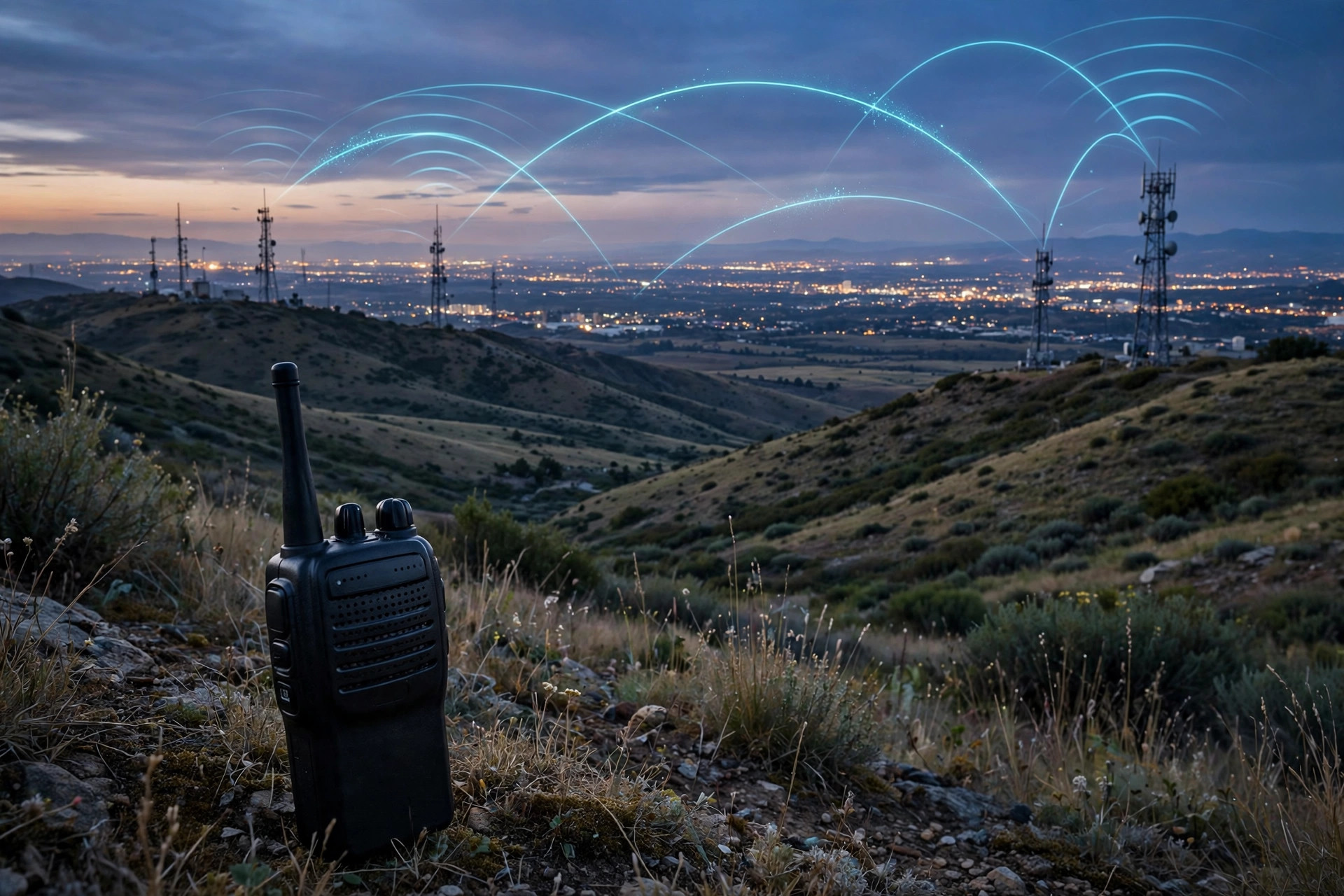
A nationwide walkie talkie is a push-to-talk voice call carried over the mobile data network — a technology called PoC, push-to-talk over cellular. When you press the button and speak, the radio digitises your voice, sends it as data to the nearest cell tower, across the internet to the service’s servers, and back down to every radio tuned to your channel. The radios at the other end can be in the next room or three thousand miles away; the path is identical either way. That is why the boxes say “nationwide” and “unlimited range”: the distance is no longer the radio’s problem. It is the network’s.
What is inside the radio
Under the familiar walkie-talkie shell — speaker, microphone, push-to-talk button, channel controls — a PoC handset is closer to a stripped-down phone than to a traditional radio. It contains an LTE modem, a SIM card (or an embedded equivalent) that identifies it to a carrier network, and software that manages channels, contacts, and calls. There is no powerful radio-frequency transmitter of the kind a GMRS set uses, because it does not need one: it only has to reach the nearest tower, not the other handset. That is also why these radios can be compact and why battery life is measured in days of standby — Echo, for instance, claims a five-day battery — rather than the hours a high-power conventional radio manages. Some models add Wi-Fi as a backup path; one model in Echo’s line, the RIGR, goes further and adds a genuine UHF radio mode for off-grid use up to roughly 10 miles over open terrain.
SIMs, service plans, and why “free” needs an asterisk
Every PoC radio needs a data connection, and data connections are a service — which is where the money lives. The brands differ in how they package it. Echo Radios includes the first year and then charges $20 per device per year, with no monthly fee and no contract. Rapid Radios includes the first twelve months and then charges around $50 per radio per year ($40 on autopay). A class of Amazon-sold brands — KaYoTom, Airiton, XOTODREM — advertises a “lifetime free” SIM at $0 per year, although XOTODREM’s lifetime requires a free renewal by IMEI number each year, and TIDRADIO, often shelved next to them, is not lifetime at all: its first year is free and then it moves to a paid plan.
The structural point matters more than any single price: a PoC radio is a small cellular subscription in disguise. Its long-term usefulness depends on a carrier network, a SIM arrangement, and a service operator continuing to exist and to honour the deal. That is not a reason to avoid the category — phones have the same dependency — but it is the reason our buyer’s guide ranks on three-year cost rather than sticker price, and the reason we print the renewal next to every headline claim.
Coverage: the honest map
Here is the sentence every PoC buyer should memorise: a nationwide walkie talkie works anywhere there is mobile data coverage, and nowhere else. Rapid Radios’ own terms say the quiet part out loud — the radio “will work only where there is cellular coverage.” In practice, coverage in the United States is broad: cities, suburbs, highways, and most towns are well served, and Echo’s radios can connect to multiple cellular networks, which reduces the chance of a dead spot compared with a single-carrier device. But coverage maps are optimistic documents. Valleys, tunnels, basements, metal-clad warehouses, rural stretches between towns, and the far side of a mountain can all drop a data connection — and when the connection drops, a pure PoC radio does not degrade gracefully the way a conventional radio does. It simply stops.
The practical advice follows from that. Before buying for a specific job, test a phone on the same class of network at the actual sites: the barn, the depot, the basement plant room. If a phone shows no data there, a PoC radio will not either. And if your work regularly leaves coverage entirely — backcountry, offshore, remote agriculture — a PoC radio is the wrong tool no matter what the box says; you want a conventional radio, or a satellite communicator, or a dual-mode handset like the RIGR whose UHF mode keeps working off-grid for a few miles.
Range truth: decoding “3,000 miles” and “5,000+ miles”
PoC marketing borrows the language of radio range for something that is not radio range. Echo advertises “over 3,000 miles.” Airiton lists “5000+ Miles.” KaYoTom listings claim up to 10,000 miles. None of these numbers describes a signal travelling from one handset to another. They describe the maximum practical separation between two people who are both inside cellular coverage — roughly, the width of the continent, or the reach of the network internationally. Two radios 3,000 miles apart with signal will connect. Two radios three miles apart, one of them in a coverage hole, will not. Our range explainer walks through every style of range claim in the industry, including the equally optimistic “36-mile” figures on conventional radios.
Latency and the feel of a conversation
A conventional radio is instant: press, speak, and the other end hears you with no perceptible delay. A PoC call has to travel up to a tower, across the internet, and down again, which adds a small delay — typically a fraction of a second to set up, and a slight lag in the conversation. Modern PoC systems keep this low enough that group coordination feels natural, and for the work these radios are bought for — dispatch, events, logistics, family coordination — it is a non-issue. It is, however, one reason PoC is not a replacement for conventional radios in split-second, on-site safety work where the team is all in one place and off-grid: there, a direct radio link is both faster and independent of infrastructure. Latency also varies with network conditions; a congested tower or a weak signal will make setup slower. Think of it as the difference between a shout across a yard and a very fast phone call with a single button — the button is the point.
Group channels: how teams are organised
PoC keeps the walkie-talkie social structure and moves it into software. Radios are organised into channels (also called groups or talkgroups): everyone on the channel hears every call on it, one person talks at a time, and switching channels is a button press or a menu selection rather than a frequency change. Fleets typically run a channel per depot or per shift; events run one for operations, one for security, one for the gate. Because channels are defined by the service rather than by radio spectrum, there is no practical limit on how many channels exist, no interference from strangers on “your” frequency, and no licence to apply for — the FCC licence that GMRS requires does not apply here, because you are not transmitting on public radio frequencies at all. Calls are also typically encrypted in transit; Echo, for example, specifies AES-256 encryption. The flip side of software-defined channels is that the service operator sits in the middle of everything — which is why Echo makes a point of its no-logging, no-location-tracking stance, and why GPS-equipped rivals make a point of the opposite. Our GPS guide covers that divide.
Security and privacy: the operator in the middle
One consequence of the architecture deserves its own paragraph. A conventional radio conversation passes directly between handsets; nobody else is involved, and anybody nearby with a receiver can listen. A PoC conversation passes through the service’s servers, which reverses both halves of that sentence: the calls can be encrypted in transit (Echo specifies AES-256) so eavesdropping is impractical, but the operator is now a party to every call’s existence — which radios talked, on which channel, and when. What the operator does with that position is a policy choice, and the brands differ loudly. Echo states that it keeps no location tracking, no data backup or storage, and no logs. GPS-class services, by design, maintain live location records for dispatchers to view. Neither is automatically sinister — a fleet’s location records are how dispatch works — but a buyer should know which side of the line their chosen service sits on, because with PoC you are not just buying radios. You are choosing who stands in the middle of your team’s conversations.
PoC versus the alternatives, in brief
PoC is one of three radio families a buyer will meet. FRS radios are licence-free, cheap, and genuinely short-range — fine for a campsite, useless across town. GMRS radios are more powerful and can use repeaters, but they need an FCC licence (about $35, covering the whole family for ten years) and their real-world range is still measured in single-digit miles outside ideal conditions. PoC trades independence for distance: unlimited practical separation inside coverage, zero function outside it. The full side-by-side — range, licensing, network dependence, and three-year cost — is in our PoC vs FRS vs GMRS comparison.
The takeaway
A nationwide walkie talkie is a phone network wearing a radio’s clothes — and that is a compliment. It keeps the one-button, whole-team simplicity that made walkie talkies useful, and removes the one limit that made them frustrating. What it cannot remove is its dependence on coverage and on a service staying alive behind the SIM. Buy it with both eyes open, and it is the most useful communications tool most teams have never tried.