Resource · Comparison
PoC vs FRS vs GMRS: three radio families, three different deals
Every handheld radio on the shelf belongs to one of three families, and the families barely overlap. One is a toy-grade convenience, one is a licensed hobbyist-and-workhorse band, and one is a phone network in disguise. Here is how they actually differ.
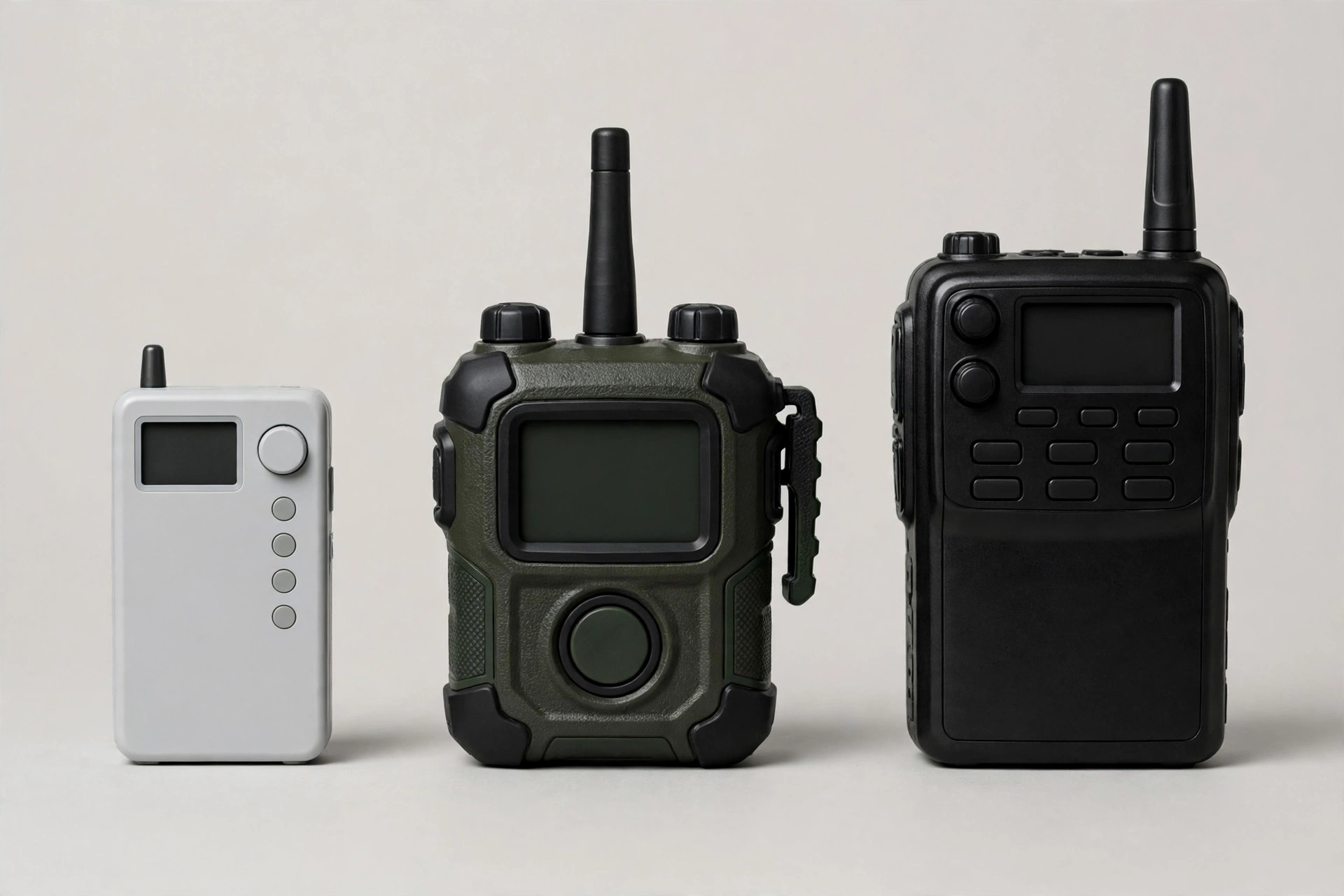
Meet the three families
FRS — the Family Radio Service — is the radio in the blister pack at the sporting-goods store. Licence-free, low power (up to 2 watts on most channels), fixed antennas, and sold in pairs for very little money. FRS is designed for short-range, casual use: campsites, ski lifts, cruise ships, kids in the neighbourhood. Its advertised ranges — sometimes 36 miles — are theoretical line-of-sight figures between mountain peaks; in a suburb, expect half a mile to a mile and a half; in a city, less. Within those limits it is honest, simple, and free to operate forever.
GMRS — the General Mobile Radio Service — is FRS’s serious older sibling. It shares some channels but allows higher power (handhelds commonly up to 5 watts, mobiles far more), detachable antennas, and — the feature that actually extends range — access to repeaters, which receive a signal and rebroadcast it from a high antenna over a wide area. The price of admission is an FCC licence: about $35, no exam, covering you and your immediate family for ten years. In open country a good GMRS handheld reaches a few miles; through a repeater, tens of miles across a metro area is realistic. GMRS is the enthusiast and preparedness community’s band of choice, and the strongest conventional option most buyers can legally run.
PoC — push-to-talk over cellular — abandons radio transmission between handsets entirely. A PoC handset is an LTE data device with a push-to-talk button: voice travels over the mobile network to the other handsets on your channel, wherever they are. Brands include Echo Radios ($159.99–$229) and Rapid Radios (~$399 per pair), plus a class of Amazon-sold GPS models from brands such as KaYoTom and Airiton. No licence is required, because the licensed spectrum belongs to the carriers. The trade is total dependence on infrastructure: no coverage, no conversation, and a service arrangement — with or without an annual fee — standing behind every handset. The technology is explained in depth in our guide to how nationwide walkie talkies work.
The comparison table
| Factor | PoC (LTE) | FRS | GMRS |
|---|---|---|---|
| How it connects | Mobile data network (LTE) | Direct radio, low power | Direct radio, higher power + repeaters |
| Real-world range | Any distance, where both ends have coverage | ~0.5–1.5 miles typical | ~1–5 miles handheld; tens of miles via repeater |
| Works with no infrastructure? | No — dead without coverage | Yes | Yes |
| FCC licence | None | None | Required (~$35, 10 years, no exam) |
| Ongoing cost | Brand-dependent: $0 claimed (Amazon class) to $20–$50/radio/yr after year 1 | None | Licence renewal only |
| Typical handset cost | $159.99–$229 (Echo); ~$399/pair (Rapid) | Low — sold in pairs | Mid — wide range by quality |
| 3-year cost per radio (typical) | ~$200–$300 incl. renewals (Echo/Rapid class) | Handset cost only | Handset + share of one $35 licence |
| GPS location options | Yes on GPS-class models (KaYoTom, Airiton); Echo is deliberately GPS-free | Rare | On some models |
| Privacy / interference | Private channels via service; encryption offered | Open channels — anyone nearby can listen | Open channels — anyone nearby can listen |
| Best at | Teams and families spread across distance | Close-range casual use | Off-grid groups, repeaters, preparedness |
Range: the number everyone shops by, and why it misleads
All three families lie about range in the same direction, but by different mechanisms. FRS and GMRS boxes quote maximum theoretical line-of-sight distances — figures measured, if they were ever measured, between two unobstructed high points. Buildings, trees, terrain, and weather eat those numbers alive; the handheld-to-handheld reality is a small fraction of the box claim. PoC boxes quote network reach — “3,000 miles,” “5,000+ miles” — which is genuinely achievable between two covered locations and genuinely meaningless in a dead zone. The honest summary: conventional radios offer a small range that is always there, and PoC offers an enormous range that is usually there. Which failure mode you prefer depends on where you stand when you press the button. We take every range claim apart in the range explainer.
Cost over three years: where PoC’s model shows
Conventional radios are a one-time purchase; the only recurring cost in the whole FRS/GMRS world is the $35 GMRS licence per decade. PoC radios are a purchase plus a service. Done honestly, the three-year arithmetic for the direct brands looks like this: an Echo radio at $199.99 with its $20 annual renewal from year two costs about $240 over three years; a Rapid radio at roughly $200 per handset (pair pricing) with its ~$50 renewal costs about $300. Amazon-class PoC radios claim $0 renewals, which would make them cheapest of all if the lifetime SIM arrangement endures — a real “if” that buyers should weigh, and one reason the direct brands’ published renewals can be the safer buy despite costing more. None of this makes PoC bad value: for a business, $20–$50 per radio per year for nationwide coordination is trivially cheap next to phone plans. It just means PoC should be compared as a service, not as a gadget.
Which family fits which job
- Choose FRS for campsites, festivals on one site, ski days, cruise ships, and kids — anywhere the whole group stays within a mile or so and simplicity matters more than reach.
- Choose GMRS for off-grid groups, rural properties, overlanding and preparedness, and any use where the infrastructure itself might be the thing that fails. Budget the licence, consider a repeater, and accept that range is local.
- Choose PoC for distributed teams — fleets, multi-site businesses, event operations across a city, families spread across states — where everyone is inside mobile coverage and distance is the whole problem. Add GPS models if dispatch needs locations, or Echo’s GPS-free radios if privacy is the point; our buyer’s guide ranks the current options.
- Choose two families if your use straddles the line: plenty of fleets run PoC day-to-day and keep GMRS sets for the dead zones. Dual-mode hardware exists precisely for this — Echo’s RIGR pairs PoC with a UHF mode good for roughly 10 miles of open terrain.
Three buyers, three answers
The multi-site operator. A cleaning company runs crews in eleven buildings across two cities. Nobody needs to talk to the next building — they need to talk to the office, the supervisor, and the other crews, all day, across town. FRS is useless beyond the car park and GMRS is a city block’s answer to a city’s problem. PoC is the only family that fits, and at $20–$50 per radio per year in renewals it undercuts giving every supervisor a phone plan. This is the buyer the nationwide category was built for.
The rural family. A family runs a property at the end of a valley with patchy mobile signal — one bar on the porch, none at the barn. PoC would fail them exactly where they need it. GMRS, with a licence, handhelds for the family, and perhaps a repeater on the high ground, gives them a few miles of infrastructure-free coverage that works in a storm, in a blackout, and on the worst day of the year. The $35 licence is the cheapest insurance in this entire comparison.
The event producer. A festival team works one large site for one long weekend a year. Inside the site, FRS or GMRS would do — but the production office is across town, the suppliers are across the county, and the team is assembled from freelancers who arrive with nothing. PoC handsets, hired or bought, with a channel per department, solve the whole map at once — as long as the site has coverage, which the producer should test on the site visit, phone in hand, before committing.
A note on the fourth family: ham radio
Amateur (“ham”) radio sits outside this comparison because it plays a different sport: it requires a licence earned by examination, it is not permitted for business use, and its GPS-equipped digital handsets dominate search results for “GPS walkie talkie” despite serving a hobbyist audience. For enthusiasts it offers the most capable and flexible radio technology of all. For a business or family that simply needs to talk, it is the wrong tool — mentioned here only so that its products are not mistaken for contenders when they surface in your research.
The short version
FRS is a convenience, GMRS is a capability, and PoC is a service. If the people you need to reach are nearby and off-grid, buy conventional radios and a licence. If they are scattered across a map and covered by towers, buy PoC — and read the renewal line before you do.